Programs Offered

The Department of Civil Engineering offers two JNTUK-affiliated programs: a four-year B.Tech in Civil Engineering and a two-year M.Tech in Structural Engineering. Both programs are designed to produce industry-ready professionals with a strong foundation in engineering principles, research aptitude, and ethical practice.

Our Programs

B.Tech — Civil Engineering

The Program Educational Objectives (PEOs) define the career and professional accomplishments that our B.Tech Civil Engineering program is designed to help graduates achieve within a few years after graduation. These objectives guide our curriculum development and ensure alignment with industry needs and societal expectations.

  • 1. Graduate will succeed in diversified fields of industry/higher studies by acquiring technical knowledge and contribute to the sustainable development of infrastructure.
  • 2. Graduate will exhibit professionalism and ethics and show ability to accept modern trends by engaging in lifelong learning.
  • 3. Graduate will apply innovative ideas and succeed as a researcher/entrepreneur to serve societal needs.

Program Outcomes (POs) describe the knowledge, skills, and attributes that students will acquire by the time of graduation. These outcomes are aligned with national accreditation standards and ensure our graduates are well-prepared for professional practice in civil engineering.

  • 1. Engineering Knowledge: The student is capable of applying the principles of basic sciences and mathematics in learning the Civil Engineering subjects. Graduates will be proficient in the core principles of Civil Engineering as they pertain to the sub-fields of Environmental Engineering, Geo-Technical Engineering, Structural Engineering, Transportation Engineering, Water Resources Engineering and will be able to apply these principles in engineering practice.
  • 2. Problem Analysis: The Graduates will possess critical thinking skills, problem solving abilities and familiarity with the computational procedures essential to the field.
  • 3. Design & Development of Solutions: The student is able to plan, analyze, design and look after the construction of various types of Civil Engineering structures with appropriate consideration for public health and safety, cultural, societal and environmental considerations.
  • 4. Conduct investigations of complex problems: The student will use research-based methods to design, conduct experiments, to analyze and interpret experimental data.
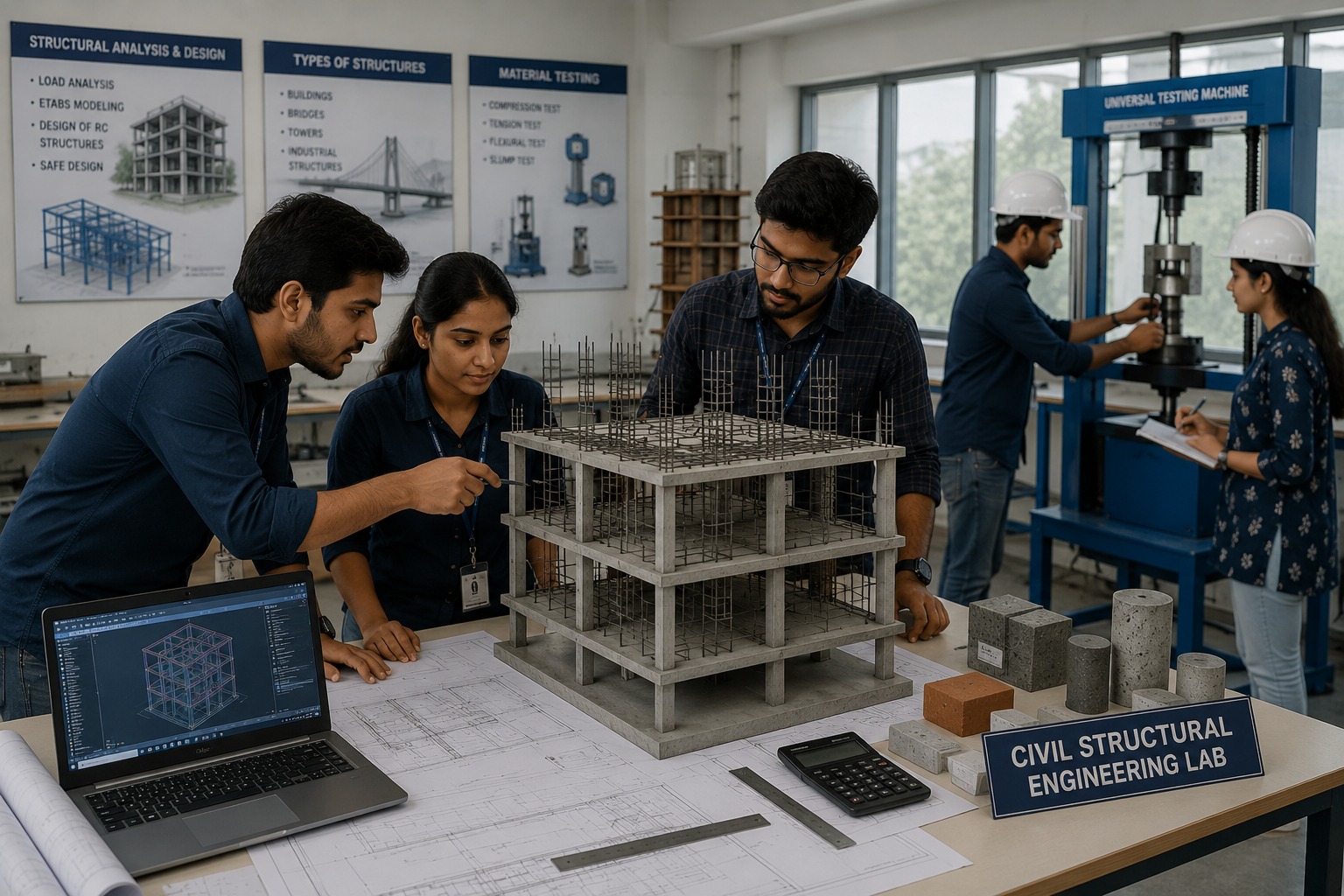
  • 5. Modern Tool Usage: The student will get hands on training in the various modern Civil Engineering software and modern equipment.
  • 6. The Engineer and Society: The students will apply reasoning and uses appropriate knowledge to assess societal, health, safety, legal and cultural issues.
  • 7. Environment and Sustainability: As the students possess substantial knowledge in multi-disciplinary subjects, they will be able to plan various projects keeping in view of its environmental effects on other related fields.
  • 8. Ethics: The student will apply ethical principles and commitment to profession and responsibilities of their profession.
  • 9. Individual and Team work: The graduate is capable of working productively as an individual, as a member or a leader in driver set teams.
  • 10. Communication: The student will possess mastery in good communication skills, expressing ideas, writing technical reports and effective managerial skills.
  • 11. Project Management and Finance: The graduates will acquire knowledge and understanding of the critical issues for professional practices such as the procurement of works, interaction with contractors during the construction phase of a project, financial and managerial capabilities.
  • 12. Lifelong Learning: The student will have an awareness of contemporary issues and will contribute to the wellbeing of the community with life-long learning in the broadest context of ever-growing technology.

Program Specific Outcomes (PSOs) are specialized competencies that distinguish our Civil Engineering program. These outcomes focus on the unique technical and professional capabilities that graduates will develop through our curriculum and laboratory experiences.

  • 1. Develop critical aptitude skills and become professional to address any problem of the society.
  • 2. Acquire practical knowledge by field visits and function effectively with the training of software by means of curriculum.
  • 3. Effectively communicate with the stakeholders and execute engineering projects with high proficiency.

M.Tech — Structural Engineering

The M.Tech Structural Engineering program is designed to develop advanced expertise in structural analysis, design, and research. Our Program Educational Objectives prepare graduates for leadership roles in industry, research organizations, and academia, with a strong emphasis on innovation and sustainable development.

  • 1. To provide students with strong foundations in basic principles and advanced concepts of Structural Engineering, enabling them to formulate, analyse, and solve societal problems related to sustainable development.
  • 2. To expose students to the latest innovations, technologies, and emerging trends, thereby fostering research orientation in Structural Engineering and multidisciplinary domains.
  • 3. To develop competent Structural Engineers who can apply core curricular knowledge for professional leadership, effective teamwork, lifelong learning, and successful career growth.

Our M.Tech program outcomes ensure that graduates possess advanced analytical and research capabilities in Structural Engineering. These outcomes reflect both AICTE guidelines and industry expectations for postgraduate engineers, emphasizing independent research, technical writing, and specialized domain mastery.

  • PO-1: An ability to independently carryout research/investigation and development work to solve practical problems.
  • PO-2: An ability to write and present a substantial technical report/document.
  • PO-3: Students should be able to demonstrate a degree of mastery over the area as per the specialization of the program. The mastery should be at a level higher than the requirements in the appropriate bachelor program.
  • PO-4: To motivate the graduate students to address the societal needs by interdisciplinary approach through advanced courses.
  • PO-5: To enrich the graduate students to get hands on training on latest equipment / software to be industry ready / pursue advanced research.
  • PO-6: To inculcate ethical practices and to establish understanding of professionalism, safety, sustainability, their duties, and contribution to the society.

The Program Specific Outcomes for M.Tech Structural Engineering focus on advanced competencies in structural analysis, design methodologies, and computational tools. These outcomes ensure graduates can handle complex structural engineering challenges and contribute to research and development in the field.
  • 1. To expose graduate students to advanced courses in analysis and design of reinforced concrete, prestressed concrete, and steel structures as per the latest design codes, with emphasis on sustainable practices and current national and international developments in Structural Engineering.
  • 2. To motivate graduate students to address societal and sustainability challenges through an interdisciplinary approach using advanced courses such as Finite Element Analysis, Plates & Shell Structures, Structural Dynamics, Soil Dynamics, and allied subjects.
  • 3. To equip graduate students with hands-on training in the latest equipment and software tools, enabling them to become industry-ready professionals and pursue advanced research for sustainable infrastructure development.